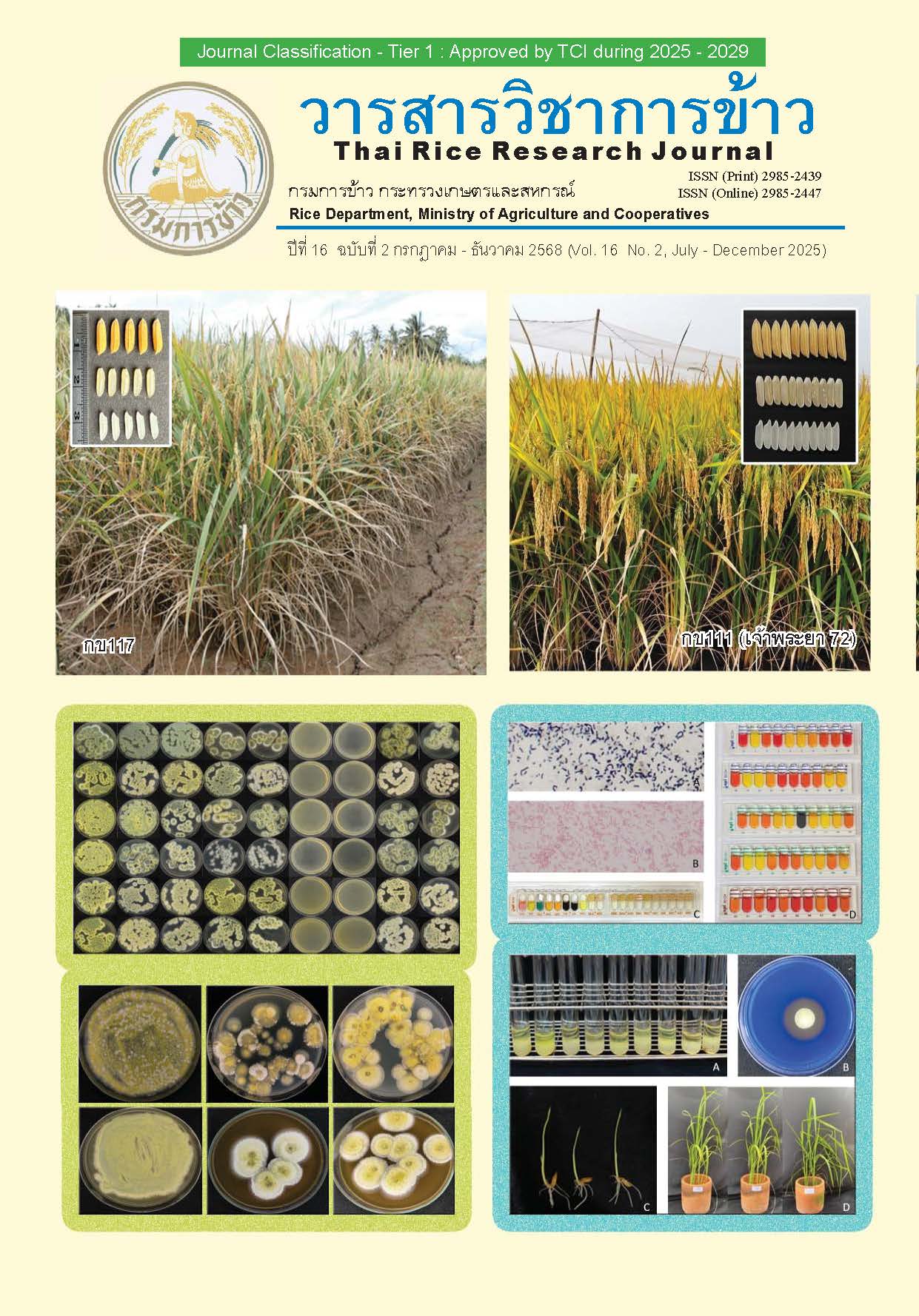
RD111 (Jao Praya 72), a Non-glutinous Rice Variety
Article Sidebar
Main Article Content
Abstract
Rice varietal development leads to higher yield potential than those of current varieties, indicating to increase in productivity and farmers income as well as an increase in our competitiveness in the world rice market. The objective of this study is to develop a photoperiod-insensitive, non-glutinous rice variety with high yield and resistance to major diseases and insect pests, suitable for irrigated rice areas in the central and lower northern while maintaining good grain quality as a market requirement. A single cross
between a high-yield non-glutinous rice line PSL09082-CNT-140-2-3-1-1-2-1 as a female parent and PSL14190-MAS (6)-CNT-15-5 (bacterial leaf blight resistance) as a male parent was made at Chai Nat Rice Research Center in 2016. The promising line named CNT16022-57-1-2-4-2 outperformed other lines in the same pedigree. During 2017-2023, this line had been under the process of selection of progenies, observations, yield trials and stability of yield in the target areas. Moreover, the evaluation for resistance to major diseases and insect pests, nitrogen response, physical and chemical properties of grain, milling and cooking quality together with stakeholders’ perception was conducted. The Thailand Rice Variety Board agreed to release it in the name of RD111 (Chao Phraya 72) for the celebrations on the auspicious occasion of His Majesty the King’s 6th cycle birthday in 2024. This new variety is a photoperiod-insensitive, non-glutinous rice with a growth duration from planting to maturity at about 100-110 days (germinated seed broadcasting) and 110-116 days (transplanting), having erect culm and moderately stiff stem with an average plant height of 112-122 cm. The average yield from multiple field trials was 870 kg/rai (potential yield at about 1,176 kg/rai). In addition, it has a high number of filled grains per panicle (248 grains), two to three weeks of seed dormancy, straw color paddy with a paddy length of 11.04 mm, 2.65 mm width and 2.06 mm thick; the length of brown rice is 8.02 mm, 2.22 mm width, and 1.88 mm thick and milled rice is 7.74 mm length, 2.16 mm width and 1.82 mm thick. The new variety has excellent milling recovery (whole kernel and head 52.14%), a long and slender shape of milled rice with less grain chalkiness approved to be 100% rice grade 1. Its non-aromatic cooked rice is quite crumbly due to high amylose content (26.68%). It is moderately resistant to bacterial leaf blight and brown planthopper but moderately susceptible to blast disease. It is recommended to grow under irrigated rice areas in central and lower northern Thailand.
Article Details
References
ศูนย์วิจัยข้าวพิษณุโลก. 2563. เอกสารประกอบการประชุมการเปรียบเทียบผลผลิตข้าวนาชลประทานในเขตภาคเหนือตอนล่าง ฤดูนาปี 2562-ฤดูนาปรัง 2563. 22-23 พฤษภาคม 2563. ศูนย์วิจัยข้าวชัยนาท, จ.ชัยนาท. 108 หน้า.
____________. 2564ก. เอกสารประกอบการประชุมการเปรียบเทียบผลผลิตข้าวนาชลประทานในเขตภาคเหนือตอนล่าง ฤดูนาปี 2563. 10 มิถุนายน 2564. ศูนย์วิจัยข้าวชัยนาท, จ.ชัยนาท. 95 หน้า.
____________. 2564ข. เอกสารประกอบการประชุมการเปรียบเทียบผลผลิตข้าวนาชลประทานในเขตภาคเหนือตอนล่างและภาคกลาง ฤดูนาปรัง 2564-ฤดูนาปี 2564. 28 ธันวาคม 2564. ศูนย์วิจัยข้าวพิษณุโลก, จ.พิษณุโลก. 102 หน้า.
____________. 2565. เอกสารประกอบการประชุมการเปรียบเทียบผลผลิตข้าวนาชลประทานในเขตภาคเหนือตอนล่างและภาคกลาง ฤดูนาปรัง 2565-ฤดูนาปี 2565. 29 ธันวาคม 2565. ศูนย์วิจัยข้าวพิษณุโลก, จ.พิษณุโลก. 112 หน้า.
____________. 2567. เอกสารประกอบการประชุมการเปรียบเทียบผลผลิตข้าวนาชลประทานในเขตภาคเหนือตอนล่างและภาคกลาง ฤดูนาปรัง 2566-ฤดูนาปี 2566. 10 มกราคม 2567. ศูนย์วิจัยข้าวชัยนาท, จ.ชัยนาท. 115 หน้า.
สำนักงานเศรษฐกิจการเกษตร. 2565. สถิติการเกษตรของประเทศไทย ปี 2565. สืบค้นจาก: https://www.oae.go.th/assets/portals/1/files/jounal/2566/yearbook2565.pdf. (1 มกราคม 2567)
อัจฉราพร ณ ลำปาง เนินพลับ, รัศมี ฐิติเกียรติพงศ์, วิชชุดา รัตนากาญจน์, วันพร เข็มมุกด์, สิทธิ์ ใจสงฆ์, พันนิภา ยาใจ, ปิยะวรรณ ใยดี, นุจรินทร์ จังขันธ์, กรสิริ ศรีนิล, ธราพร ยืนยงค์, ดวงกมล บุญช่วย, อนรรฆพล บุญช่วย, ดวงพร วิธูรจิตต์, นิตยา รื่นสุข, เฉลิมขวัญ ฉิมวัย, เฉลิมชาติ ฤาไชยคาม, กนกอร ดอกไม้เทศ, วรรณพรรณ จันลาภา, ทัสดาว เกตุเนตร, เฉลิมพล เฉลิมพลโยธิน, สมหมาย ศรีวิสุทธิ์, นภดล ประยูรสุข, ชนสิริน กลิ่นมณี และเสาวนีย์ ศรีบัว. 2557. ผลของการเปลี่ยนแปลงสภาพภูมิอากาศที่มีต่อชนิดของเชื้อสาเหตุและการระบาดของโรคข้าวในนาชลประทานที่ปลูกต่อเนื่อง. หน้า 241-262. ใน: การประชุมวิชาการข้าวและธัญพืชเมืองหนาว ครั้งที่ 31 พ.ศ. 2557. 21-23 พฤษภาคม 2557. โรงแรมรอยัลพลาคลิฟฟ์บีชรีสอร์ทแอนด์สปา, จ.ระยอง.
Beachell, H.M., G.S. Khush and R.C. Aquino. 1972. IRRI’s international breeding program. pp. 89-106. In: Rice breeding. International Rice Research Institute, Los Baños, Philippines.
Eberhart, S.A. and W.A. Russell. 1966. Stability parameters for comparing varieties. Crop Science 6: 36-40.
Gallagher, K.D., P.E. Kenmore and K. Sogawa. 1994. Judicial use of insecticides deter planthopper outbreaks and extend the life of resistant varieties in Southeast Asian rice. pp. 599-614. In: R.F. Denno and T.J. Perfect, (eds.), Planthoppers: Their Ecology and Management. Chapman & Hall, New York.
Heinrichs, E.A., F.G. Medrano and H.R. Rapusus. 1985. Genetic Evaluation for Insect Resistance in Rice. International Rice Research Institute, Los Baños, Philippines. 352 p.
IRRI. 2014. Standard Evaluation System for Rice (SES). International Rice Research Institute, Los Baños, Philippines. 57 p.
Ishiyama, S. 1922. Studies on bacterial leaf blight of rice. Report of Agricultural Experiment Station 45: 233-261.
Peng, S., G.S. Khush and K.G. Cassman. 1994. Evaluation of the new plant type ideotype for increased yield potential. pp. 5-20. In: K.G. Cassman, (ed.), Breaking the Yield Barrier. International Rice Research Institute, Los Baños, Philippines.
Swings, J., M.V.D. Mooter, L. Vauterin, B. Hoste, M. Gillis, T.W. Mew and K. Kersters. 1990. Reclassification of the causal agents of bacterial blight (Xanthomonas campestris pv. oryzae) and bacterial leaf streak (Xanthomonas campestris pv. oryzicola) of rice as pathovars of Xanthomonas oryzae (ex Ishiyama 1922) sp. nov., nom. rev. International Journal of Systematic and Evolutionary Microbiology 40: 309-311.
