RD113, a Non-glutinous Rice Variety
Article Sidebar
Main Article Content
Abstract
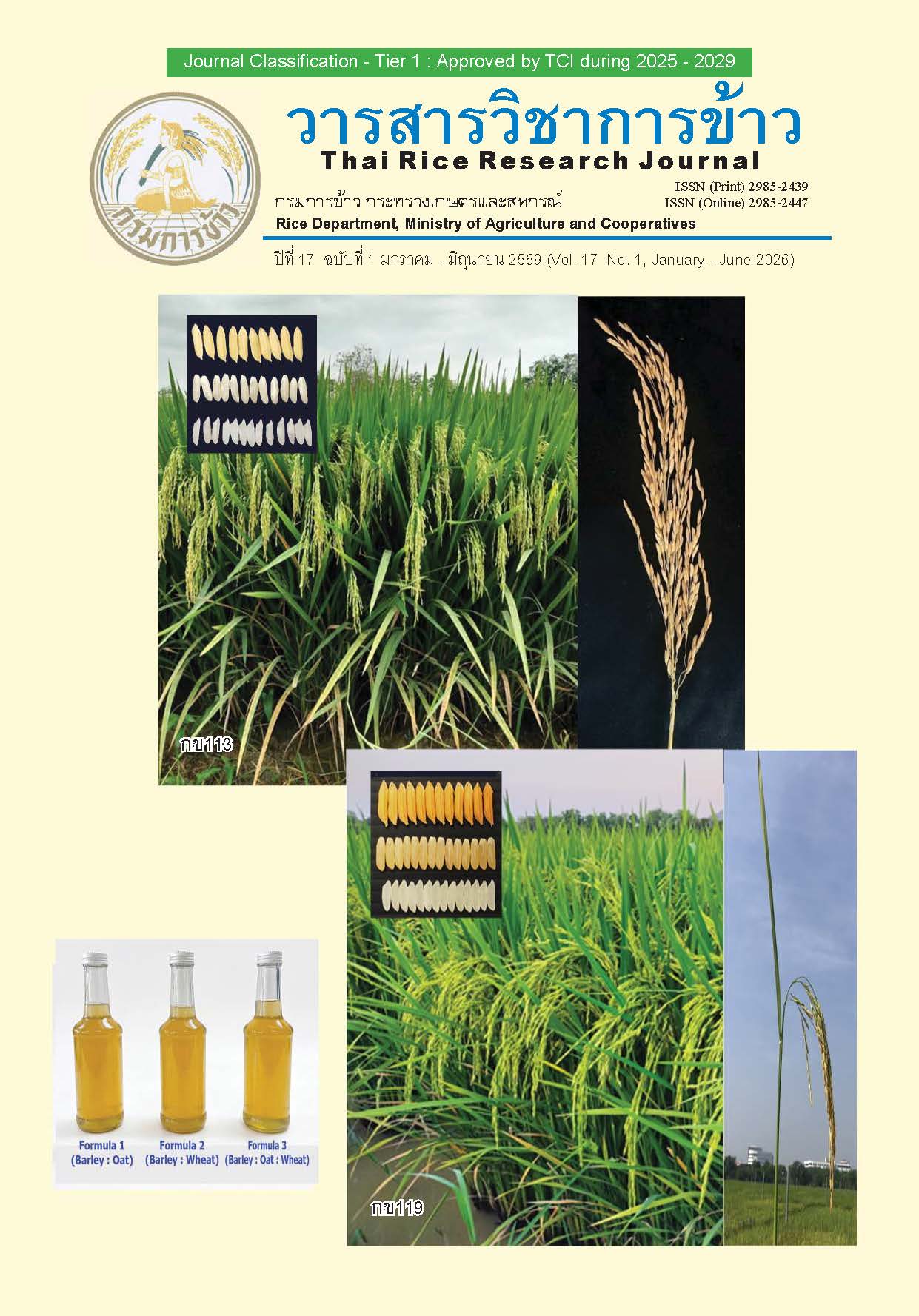
Currently, foreign rice consumers are turning to soft-textured rice, resulting in high competition in the market for this type of rice. In addition, competing countries such as Vietnam can produce more of this type, both in quantity and quality, and the cost is low. Although the Rice Department has certified several soft-textured rice varieties, such as RD39, RD43, RD53, RD77, RD79, RD87, and RD97, they are not widely cultivated due to their long growth duration, rather low yields, susceptibility to rice diseases and insect pests, and the fact that some varieties are not adapting well to the environment. To provide more options for farmers and increase our competitiveness in the global rice market, this type of rice variety has been developed to be diverse and suitable for the environment under the cooperation of the Hybrid Rice Development Consortium (HRDC). The single cross between Ming Hui 63 and IR80897-84-2-2-1 was made at the International Rice Research Institute (IRRI). The F2 populations were then introduced in 2012, and continued pedigree selection from F3 to F8 at the Pathum Thani Rice Research Center resulted in the outstanding line IR96522-PTT-5-1-2-1-4-1 in 2015. This line had been under the processes of observation, yield trials, and nitrogen response, as well as evaluation of the resistance to major diseases and insect pests, physical and chemical properties of grain, and milling and cooking quality; the total period of this varietal development was 2012-2025. The Thailand Rice Variety Board agreed to release it in the name of RD113. It is non-photoperiod sensitive, has a maturity from planting of 105-110 days (germinated seed broadcasting) and 107-115 days (transplanting), an average height of 117 cm with erect culm and stiff stem, green leaves, and a flag leaf length and width of 43.8 and 1.70 cm, respectively. It holds medium compact panicles with a length of 28.10 cm and just above the exertion from the flag leaf, moderately shattering, with 158 filled grains/panicle. The average yield was 946 kg/rai, with the highest yield of 1,124 kg/rai at a farmer’s field in Suphan Buri province. Its weight of 1,000 dry paddy seeds was 28.84 g, with a seed dormancy of five weeks and straw-colored paddy with a length of 10.49 mm, a width of 2.77 mm, and a thickness of 2.06 mm. The length of brown rice is 7.51 mm, with a 2.39 mm width and 1.82 mm thickness, together with 7.26 mm milled rice length, 2.25 mm width, and 1.74 mm thickness, considered a slender shape. It has good milling quality, with whole kernel and head rice of 43.50%. This variety has low amylose content (16.84%), soft gel consistency, and low gelatinization temperature with 10.01% protein in brown rice. The quality of cooked rice is white, soft with moderate stickiness, and not fragrant. Very high resistance to leaf blast at the seedling stage was found in Chai Nat, Phitsanulok, Ratchaburi, Prachinburi, and Pathum Thani provinces. It is moderately resistant to isolates of bacterial leaf blight from Chai Nat and Phitsanulok provinces but highly susceptible to brown planthopper. RD113 is suitable for planting in irrigated rice production systems in the central and lower northern parts of Thailand, where leaf blast always occurs at the seedling stage.
Article Details
References
สำนักงานเศรษฐกิจการเกษตร. 2567. ภาวะเศรษฐกิจการเกษตรปี 2567 และแนวโน้มปี 2568. กองนโยบายและแผนพัฒนาการเกษตร สำนักงานเศรษฐกิจการเกษตร. สืบค้นจาก: https://www.oae.go.th/assets/portals/1/fileups/bappdata/files/Outlook_Y_2567-68(2).pdf. (10 กุมภาพันธ์ 2568)
Eberhart, S.A. and W.A. Russell. 1966. Stability parameters for comparing varieties. Crop Science 6: 36-40.
Heinrichs, E.A., F.G. Medrano and H.R. Rapusus. 1985. Genetic Evaluation for Insect Resistance in Rice. International Rice Research Institute, Los Baños, Philippines. 352 p.
IRRI. 2014. Standard Evaluation System for Rice (SES). International Rice Research Institute, Los Baños, Philippines. 57 p.
Ishiyama, S. 1922. Studies on bacterial leaf blight of rice. Report of Agricultural Experiment Station 45: 233-261.
Swings, J., M.V.D. Mooter, L. Vauterin, B. Hoste, M. Gillis, T.W. Mew and K. Kersters. 1990. Reclassification of the causal agents of bacterial blight (Xanthomonas campestris pv. oryzae) and bacterial leaf streak (Xanthomonas campestris pv. oryzicola) of rice as pathovars of Xanthomonas oryzae (ex Ishiyama 1922) sp. nov., nom. rev. International Journal of Systematic and Evolutionary Microbiology 40: 309-311.
