Soil Microorganisms for Utilization of Biofertilizer Production for Rice
Article Sidebar
Main Article Content
Abstract
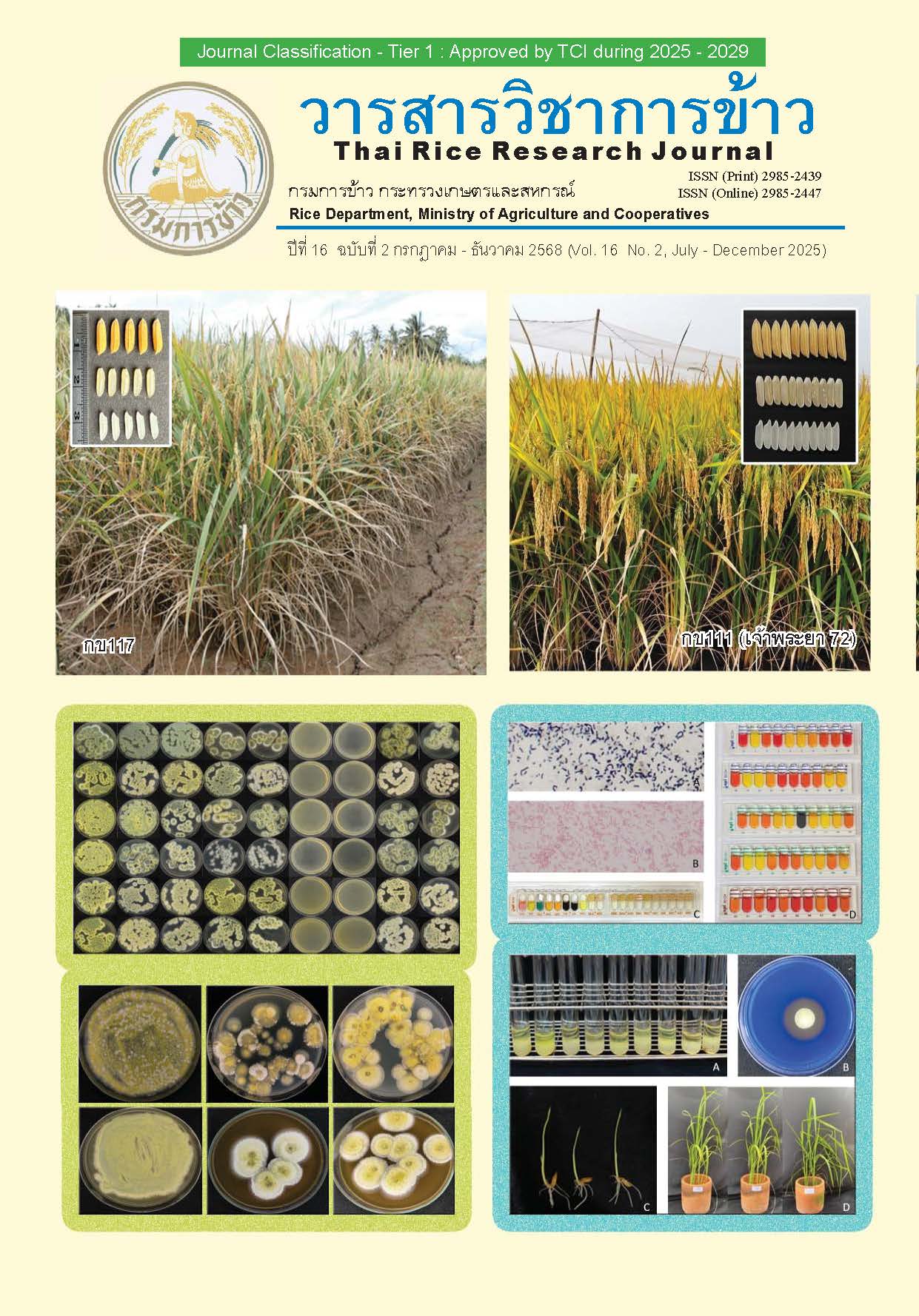
Utilization of plant growth-promoting rhizobacteria (PGPR) in rice fields is one approach to enhancing soil fertility and benefiting the plants sustainably. This study aimed to select and identify plant growth-promoting rhizobacteria (PGPR) from soil, rhizosphere, and roots of rice in both irrigated and rainfed lowland ecosystems for potential development into a biofertilizer. The research evaluated twenty-eight bacterial isolates that exhibited at least two beneficial traits related to plant growth promotion, including nitrogen fixation, indole-3-acetic acid production, or phosphate solubilization. These isolates were isolated from soil, rhizosphere soil, and rice roots collected in 2023. Additionally, we assessed their capacity to produce gibberellins and siderophores, as well as the enhancement of germination in the 7-day-old Khao Dok Mali 105 (KDML105) rice variety in petri dishes. As a result, 11 representative bacterial isolates that exhibited at least three beneficial traits were selected and tested on the KDML105 rice variety under greenhouse conditions at Division of Rice Research and Development, Rice Department in 2024. The shoot length, root length, and dry weight of rice plants that are 30 days old were measured. The results revealed that nine bacterial isolates promoted both shoot and root growth of rice as well as dry biomass. So, the nine bacterial isolates were identified based on morphological and biochemical characteristics, 16S-23S rDNA nucleotide sequence analysis, and multilocus sequence analysis by using housekeeping genes. They were classified as Burkholderia vietnamiensis (1 isolate), Burkholderia diffusa (1 isolate), Ralstonia mannitolilytica (2 isolates), Bacillus cabrialesii (2 isolates), Bacillus subtilis (2 isolates), and Brucella sp. (1 isolate). The results of this study indicate that two isolates of B. cabrialesii: NPT-CHEM2-RS-02_Bc_2023 and SRI-ORG1-RS-06_Bc_2023, along with two isolates of B. subtilis: NMA-CHEM2-11_Bc_2023 and SMKPT1-02 CHEM_Bc_2023, have been chosen for further field trials and for further development as a rice biofertilizer. These bacterial isolates demonstrate significant potential as PGPR and are safe for use, as they are not pathogenic to humans, animals, or plants.
Article Details
References
กรมวิชาการเกษตร. 2564. ปุ๋ยชีวภาพ. กองวิจัยพัฒนาปัจจัยการผลิตทางการเกษตร, กรุงเทพมหานคร. 20 หน้า.
กัลยกร โปร่งจันทึก และภัสชญภณ หมื่นแจ้ง. 2560. การใช้ปุ๋ยชีวภาพพีจีพีอาร์เพื่อลดต้นทุนการผลิตพืช. หน้า 99-105. ใน: ผลงานวิจัยเด่น/ผลงานเด่น ปี 2558-2559. กรมวิชาการเกษตร, กรุงเทพฯ. 150 หน้า.
จิรพันธ์ เปรมสุริยา, วราภรณ์ ปานอยู่, สุจินต์ ภัทรภูวดล และวิชัย โฆสิตรัตน. 2560. การพัฒนาวิธีการที่รวดเร็วในการคัดเลือกเชื้อไรโซแบคทีเรียส่งเสริมการเจริญเติบโตของข้าว. วารสารวิทยาศาสตร์เกษตร 48(1): 12-23.
ประกาศกระทรวงสาธารณสุข. 2561. เรื่อง รายการเชื้อโรคที่ประสงค์ควบคุมตามมาตรา 18 พ.ศ. 2561. ราชกิจจานุเบกษา เล่ม 139 ตอนพิเศษ 177 ง (ประกาศเมื่อ 27พฤศจิกายน 2561). 6-125.
วันวิสาข์ เพ็ชรอำไพ, จุฑาเทพ วัชระไชยคุปต์, สุจินต์ ภัทรภูวดล และวิชัย โฆสิตรัตน. 2560. การจำแนกเชื้อแบคทีเรียสาเหตุโรครวงไหม้ และเมล็ดด่างของข้าวโดยการวิเคราะห์ลำดับเบสของกลุ่มยีน. วารสารวิทยาศาสตร์เกษตร 48(2): 297-311.
ศุภชาติ ธรรมนิติเวทย์. 2564. ไรโซแบคทีเรียส่งเสริมการเจริญเติบโตของพืช: หลักการและการใช้ประโยชน์. วารสารเกษตรนเรศวร 18: e0180190.
สุวรรณี แทนธานี. 2560. จุลินทรีย์...เทคโนโลยีชีวภาพเพื่อการปรับปรุงบำรุงดิน. วารสารกรมวิทยาศาสตร์บริการ 60(190): 36-39.
อริษา จิตรติกรกุล, ไอลดา ชุมแสง, จีรนันท์ นิติเศรษฐ์, ธีรดา หวังสมบูรณ์ดี และพยอม โคเบลลี่. 2567. ชนิดและประชากรของจุลินทรีย์ดินที่เป็นประโยชน์ทางการเกษตรในระบบการผลิตข้าวของประเทศไทย. หน้า 99-116. ใน: เอกสารสืบเนื่องการประชุมทางวิชาการ ดินและปุ๋ยแห่งชาติ ครั้งที่ 8. วันที่ 11-12 กรกฎาคม 2567. มหาวิทยาลัยนเรศวร, จ.พิษณุโลก. 311 หน้า.
Ahmed, E. and S.J.M. Holmström. 2014. Siderophores in environmental research: roles and applications. Microbrial Biotechnology 7(3): 196-208.
Ahmed, I., M. del Mar Jiménez-Gascob, D.S. Luthec, S.N. Shakeeld and M.E. Barberchecka. 2020. Endophytic Metarhizium robertsii promotes maize growth, suppresses insect growth, and alters plant defense gene expression. Biological Control 144: 104167.
Alexander, D.B. and D.A. Zuberer. 1991. Use of chrome azurol S reagents to evaluate siderophore production by rhizosphere bacteria. Biology and Fertility of Soils 12: 39-45.
Ayyaz, M., Z. Khan, N. Tabbasam, T. Sultan, A. Saeed and M. Shan. 2021. Isolation and characterization of plant growth promoting rhizobacteria for growth promotion of rice (Oryza sativa L.) and wheat (Triticum aestivum). Pakistan Journal of Biochemistry and Biotechnology 2(2): 177-194.
Bhardwaj, D., M.W. Ansari, R.K. Sahoo and N. Tuteja. 2014. Biofertilizers function as key player in sustainable agriculture by improving soil fertility, plant tolerance and crop productivity. Microbial Cell Factories 13(1): 66.
Hasan, A., B. Tabassum, M. Hashim and N. Khan. 2024. Role of plant growth promoting rhizobacteria (PGPR) as a plant growth enhancer for sustainable agriculture: A review. Bacteria 3: 59-75.
Hördt, A., M.G. López, J.P. Meier-Kolthoff, M. Schleuning, L.M. Weinhold, B.J. Tindall, S. Gronow, N.C. Kyrpides, T. Woyke and M. Göker. 2020. Analysis of 1,000+ Type-Strain Genomes Substantially Improves Taxonomic Classification of Alphaproteobacteria. Frontiers in Microbiology 11: 468.
Kang, S.M., A.L. Khan, M. Hamayun, J. Hussain, G.J. Joo, Y.H. You, J.G. Kim and I.J. Lee. 2012. Gibberellin-producing Promicromonospora sp. SE188 improves Solanum lycopersicum plant growth and influences endogenous plant hormones. Journal of Microbiology 50: 902-909.
Le, X.T., D.T. Pham, T.A. Pham, T.T. Tran, T.H. Khuat, H.Q. Le and U.N. Vu. 2019. Exploration of genetic diversity of Bacillus spp. from industrial shrimp ponds in Vietnam by multi-locus sequence typing. Fisheries and Aquatic Sciences 22(17): 1-9.
Paleg, L.G. 1965. Physiological effects of gibberellins. Annual Review of Plant Biology 16: 291-322.
Payne, G.W., P. Vandamme, S.H. Morgan, J.J. LiPuma, T. Coenye, A.J. Weightman, T.H. Jones and E. Mahenthiralingam. 2005. Development of a recA gene-based identification approach for the entire Burkholderia genus. Applied and Environmental Microbiology 71: 3917-3927.
Rana, A., M. Joshi, S. Yadav and B. Saharan. 2012. Identification of multi-trait PGPR isolates and evaluating their potential as inoculants for wheat. Annals of Microbiology 62(3): 1241-1250.
Santos, P.E. de los, P. Vinuesa, L. Martínez-Aguilar, A.M. Hirsch and J. Caballero-Mellado. 2013. Phylogenetic analysis of Burkholderia species by multilocus sequence analysis. Current Microbiology 67: 51-60.
Shah, A., M. Nazari, M. Antar, L.A. Msimbira, J. Naamala, D. Lyu, M. Rabileh, J. Zajonc and D.L. Smith. 2021. PGPR in agriculture: A sustainable approach to increasing climate change resilience. Frontiers in Sustainable Food Systems 5: 1-22.
Sun, W., and M.H. Shahrajabian. 2025. Biostimulant and beyond: Bacillus spp., the important plant growth-promoting rhizobacteria (PGPR)-based biostimulant for sustainable agriculture. Earth Systems and Environment 9: 1465-1498.
Tilman, D., K.G. Cassman, P.A. Matson, R. Naylor and S. Polasky. 2002. Agricultural sustainability and intensive production practices. Nature 418: 671-677.
Vessey, J.K. 2003. Plant growth promoting rhizobacteria as biofertilizers. Plant and Soil 255: 571-586.
Weisburg, W.G., S.M. Barns, D.A. Pelletier and D.J. Lane. 1991. 16S Ribosomal DNA amplification for phylogenetic study. Journal of Bacteriology 173(2): 697-703.
