RD119, a Non-glutinous Rice Variety
Article Sidebar
Main Article Content
Abstract
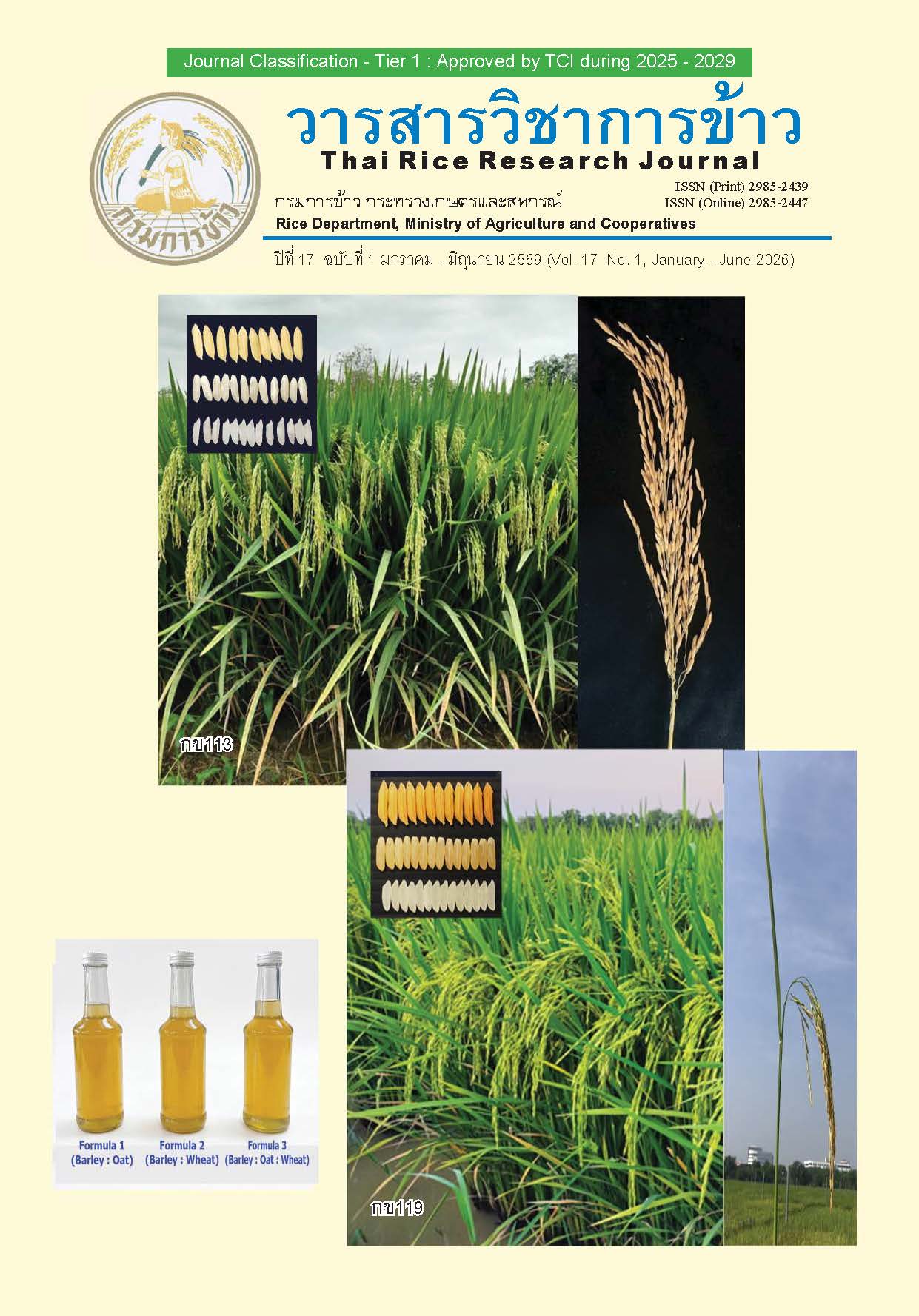
Thai fragrant, non-glutinous rice, with aroma and sticky texture when cooked and photoperiod insensitivity allowing year-round cultivation, is in high demand but the production is insufficient for market demands. Because some of those varieties have low yields, they are not resistant to blast disease, have long growth duration, and their yield and quality vary depending on the area and environmental conditions in each season. Therefoe, breeding photoperiod insensitive, non-glutinous, fragrant rice varieties with short growth duration, high yield and resistance to blast disease is another option. This type of rice variety has been developed under the cooperation of Phitsanulok Rice Research Center and the National Science and Technology Development Agency (NSTDA). The single cross between IR738349 and SPR91062 was made, then crossbred it with the Pin Kaset rice variety at NSTDA. Growing of F1 seeds followed by pedigree selection of F2 to F7 populations were conducted at Chai Nat Rice Research Center resulted in the outstanding line BioH95-CNT-60-1-1-1-2-1. This line had been under the processes of observation, yield trials, evaluation for resistance to major diseases and insect pests, nitrogen fertilizer response, physical and chemical properties of grain, milling and cooking qualities. The total period of this varietal development was during 2013-2023. The Thailand Rice Variety Board agreed to release it in the name of RD119 in 2025. It is a non-glutinous, photoperiod insensitive and fragrant rice variety, has a maturity from planting of 95-100 days (germinated seed broadcasting) and 105-115 days (transplanting) considerably shorter than that of Pathum Thani 1 rice variety, an average height of 109-115 cm with erect culm and stiff stem, green leaves, and a flag leaf length and width of 40.60 and 1.20 cm, respectively. It holds medium compact panicle just above the exertion from the flag leaf with a length of 30.10 cm, 141 filled grains/panicle and shattering. The highest yield was 993 kg/rai, with an average yield of 777 kg/rai, approximately 13% higher than that of Pathum Thani 1 rice variety. Its seed dormancy was four weeks, weight of 1,000 dry paddy was 28.66 g, a straw-colored paddy with 11.20 mm length, 2.59 mm width, and 2.01 mm thickness. The length of brown rice was 8.31 mm with 2.13 mm width and 1.87 mm thickness, together with 7.93 mm milled rice length, 2.07 mm width and 1.82 mm thickness, considered a slender shape. It has good milling quality, with whole kernel and head rice of 40.58%. This variety has low amylose content (17.21%), soft gel consistency, and low gelatinization temperature with 9.54% protein in brown rice. The quality of cooked rice is soft and sticky with aroma (2AP: 1.61 ppm). It showed moderate resistance to leaf blast at the seedling stage in Chai Nat, Phitsanulok, Lop Buri, and Prachin Buri provinces. It is moderately susceptible to populations of brown planthopper from Chai Nat, Phitsanulok and Lop Buri provinces but susceptible to isolates of bacterial leaf blight from Phitsanulok Rice Research Center. RD119 is suitable for planting in irrigated rice production systems in the lower northern, central, and upper northern parts of Thailand, where no regular outbreaks of brown planthopper and bacterial leaf blight were found.
Article Details
References
วัชระ ภูรีวิโรจน์กุล. 2534. การปรับปรุงพันธุ์ข้าวต้านทานโรคและแมลง. เอกสารวิชาการศูนย์วิจัยข้าวปทุมธานี. สถาบันวิจัยข้าว, กรมวิชาการเกษตร. กรุงเทพฯ. 116 หน้า.
ศูนย์วิจัยข้าวพิษณุโลก. 2560. เอกสารประกอบการประชุมการเปรียบเทียบผลผลิตข้าวนาชลประทานในเขตภาคเหนือตอนล่าง ฤดูนาปี 2559-ฤดูนาปรัง 2560. 23-24 มิถุนายน 2560. ศูนย์วิจัยข้าวชัยนาท, จ.ชัยนาท. 109 หน้า.
______________. 2561. เอกสารประกอบการประชุมการเปรียบเทียบผลผลิตข้าวนาชลประทานในเขตภาคเหนือตอนล่าง ฤดูนาปี 2560-ฤดูนาปรัง 2561. 21- 22 มิถุนายน 2561. ศูนย์วิจัยข้าวชัยนาท, จ.ชัยนาท. 105 หน้า.
______________. 2562. เอกสารประกอบการประชุมการเปรียบเทียบผลผลิตข้าวนาชลประทานในเขตภาคเหนือตอนล่าง ฤดูนาปี 2561-ฤดูนาปรัง 2562. 12 มิถุนายน 2562. ศูนย์วิจัยข้าวเชียงราย, จ.เชียงราย. 112 หน้า.
______________. 2563. เอกสารประกอบการประชุมการเปรียบเทียบผลผลิตข้าวนาชลประทานในเขตภาคเหนือตอนล่าง ฤดูนาปี 2562-ฤดูนาปรัง 2563. 22-23 พฤษภาคม 2563. ศูนย์วิจัยข้าวชัยนาท, จ.ชัยนาท. 108 หน้า.
______________. 2564ก. เอกสารประกอบการประชุมการเปรียบเทียบผลผลิตข้าวนาชลประทานในเขตภาคเหนือตอนล่าง ฤดูนาปี 2563. 10 มิถุนายน 2564. ศูนย์วิจัยข้าวชัยนาท, จ.ชัยนาท. 95 หน้า.
______________. 2564ข. เอกสารประกอบการประชุมการเปรียบเทียบผลผลิตข้าวนาชลประทานในเขตภาคเหนือตอนล่างและภาคกลาง ฤดูนาปรัง 2564-ฤดูนาปี 2564. 28 ธันวาคม 2564. ศูนย์วิจัยข้าวพิษณุโลก, จ.พิษณุโลก. 102 หน้า.
สถาบันสารสนเทศทรัพยากรน้ำและการเกษตร. 2556. ลุ่มน้ำในประเทศไทย. สืบค้นจาก: http://www.haii.or.th/wiki/index.php/. (15 มิถุนายน 2568)
สำนักนโยบายและยุทธศาสตร์ข้าว. 2561. การประชุมสัมมนาการวางแผนการผลิตข้าวประจำปี ภายใต้แผนการผลิตและการตลาดข้าวครบวงจร. 27-29 มีนาคม 2561. โรงแรมแอมบาสซาเดอร์ ซิตี้ จอมเทียน, จ.ชลบุรี. 69 หน้า.
อรอนงค์ โคกสูงเนิน และวิชชุดา รัตนากาญจน์. 2562. การเฝ้าระวังและเตือนภัยการระบาดของเพลี้ยกระโดดสีน้ำตาลและโรคไหม้. หน้า 146-159. ใน: การประชุมวิชาการกรมการข้าว ประจำปี 2562. 12-13 มีนาคม 2562. โรงแรมมารวย การ์เด้น, กรุงเทพฯ.
อัจฉราพร ณ ลำปาง เนินพลับ, รัศมี ฐิติเกียรติพงศ์, วิชชุดา รัตนากาญจน์, วันพร เข็มมุกด์, สิทธิ์ ใจสงฆ์, พันนิภา ยาใจ, ปิยะวรรณ ใยดี, นุจรินทร์ จังขันธ์, กรสิริ ศรีนิล, ธราพร ยืนยงค์, ดวงกมล บุญช่วย, อนรรฆพล บุญช่วย, ดวงพร วิธูรจิตต์, นิตยา รื่นสุข, เฉลิมขวัญ ฉิมวัย, เฉลิมชาติ ฤาไชยคาม, กนกอร ดอกไม้เทศ, วรรณพรรณ จันลาภา, ทัสดาว เกตุเนตร, เฉลิมพล เฉลิมพลโยธิน, สมหมาย ศรีวิสุทธิ์, นพดล ประยูรสุข, ชนสิริน กลิ่นมณี และเสาวนีย์ ศรีบัว. 2557. ผลของการเปลี่ยนแปลงสภาพภูมิอากาศที่มีต่อชนิดของเชื้อสาเหตุและการระบาดของโรคข้าวในนาชลประทานที่ปลูกต่อเนื่อง. หน้า 241-262. ใน: การประชุมวิชาการข้าวและธัญพืชเมืองหนาว ครั้งที่ 31 พ.ศ. 2557. 21-23 พฤษภาคม 2557. โรงแรมรอยัลพลา คลิฟฟ์ บีช รีสอร์ทแอนด์สปา, จ.ระยอง.
Eberhart, S.A. and W.A. Russell. 1966. Stability parameters for comparing varieties. Crop Science 6: 36-40.
Gallagher, K.D., P.E. Kenmore and K. Sogawa. 1994. Judicial use of insecticides deter planthopper outbreaks and extend the life of resistant varieties in Southeast Asian rice. pp 599-614. In: R.F. Denno and T.J. Prtfect, (eds.). Planthoppers: Their Ecology and Management. Chapman & Hall, New York.
Heinrichs, E.A., F.G. Medrano and H.R. Rapusus. 1985. Genetic Evaluation for Insect Resistance in Rice. International Rice Research Institute, Los Baños, Philippines. 352 p.
IRRI. 2014. Standard Evaluation System for Rice (SES). International Rice Research Institute, Los Baños, Philippines. 57 p.
Ishiyama, S. 1922. Studies on bacterial leaf blight of rice. Report of Agricultural Experiment Station 45: 233-261.
Swings, J., M.V.D. Mooter, L. Vauterin, B. Hoste, M. Gillis, T.W. Mew and K. Kersters. 1990. Reclassification of the causal agents of bacterial blight (Xanthomonas campestris pv. oryzae) and bacterial leaf streak (Xanthomonas campestris pv. oryzicola) of rice as pathovars of Xanthomonas oryzae (ex Ishiyama 1922) sp. nov., nom. rev. International Journal of Systematic and Evolutionary Microbiology 40: 309-311.
