Effect of Thai-Grown Temperate Cereal Malts on Physicochemical and Sensorial Properties of Craft Beer
Article Sidebar
Main Article Content
Abstract
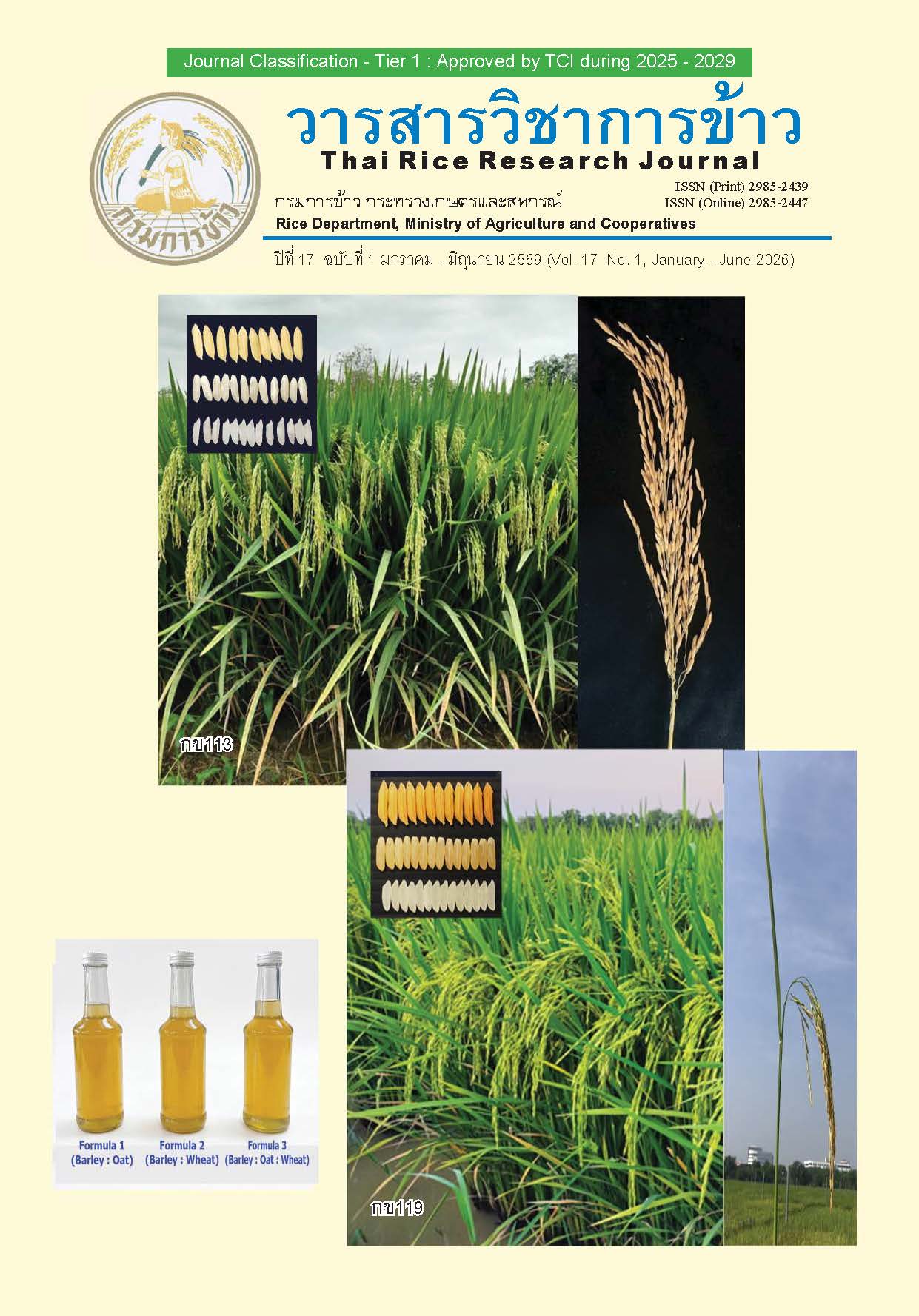
The contemporary craft beer industry increasingly seeks local adjuncts to establish unique product identities and enhance agricultural value. However, empirical data regarding the application of temperate cereals cultivated in Thailand as alternative brewing ingredients remains limited. Therefore, this study aimed to evaluate the physicochemical and sensory properties of beer brewed from Thai-grown temperate cereals malted, including barley line FNBLS#140, oat line SMGOTC21099 and wheat variety RDW1 (Samoeng 72). Three brewing formulations were investigated: Formula 1 (barley mixed with oats), Formula 2 (barley mixed with wheat), and Formula 3 (barley mixed with both oats and wheat). The results indicated that the grain composition significantly influenced the physicochemical characteristics of the beer (p≤0.05). Specifically, Formula 1 exhibited the highest lightness value (L*) and received the highest color preference score from untrained panelists. Formula 2 demonstrated the highest yellowness value (b*) and turbidity, whereas Formula 3 yielded the highest viscosity and total soluble solids. Conversely, variations in grain combinations did not significantly impact the protein content, ash content, alcohol by volume (ABV, ranging from 7.50% to 7.53%), or overall sensory acceptability. These findings substantiate the potential of Thai temperate cereals as viable alternative brewing ingredients, offering a practical approach to modulating beer characteristics, consumer acceptability, and generating value-added agricultural products.
Article Details
References
กองนโยบายเทคโนโลยีเพื่อการเกษตรและเกษตรกรรมยั่งยืน. 2567. แผนแนวทางการส่งเสริมการปลูกข้าวสาลีและพืชเศรษฐกิจหลังนาอินทรีย์ ปรับเปลี่ยนพื้นที่นาปรังเป้าหมาย 2,000 ไร่. สำนักงานปลัดกระทรวงเกษตรและสหกรณ์, กระทรวงเกษตรและสหกรณ์.
กฤษนันท์ พันธ์ประภากิจ. 2563. การพัฒนาผลิตภัณฑ์คราฟต์เบียร์โดยเทคนิคการวิเคราะห์แบบคอนจ้อยท์. บริหารธุรกิจมหาบัณฑิต สาขาวิชาการตลาด, มหาวิทยาลัยศรีนครินทรวิโรฒ.
ชูศักดิ์ จอมพุก. 2555. สถิติ : การวางแผนการทดลองและการวิเคราะห์ข้อมูลในงานวิจัยด้านพืชด้วย “R”. พิมพ์ครั้งที่ 2 ฉบับปรับปรุง. มหาวิทยาลัยเกษตรศาสตร์, กรุงเทพฯ. 335 หน้า.
โชคชัย วนภู. 2558. การหาสภาวะที่เหมาะสมในการผลิตเบียร์จากข้าวไทยเป็นส่วนประกอบหลักโดยวิธีพื้นที่ผิวตอบสนองและการประยุกต์ใช้ในการผลิตเบียร์ระดับกึ่งอุตสาหกรรม. รายงานการวิจัยฉบับสมบูรณ์. สาขาเทคโนโลยีชีวภาพ สำนักวิชาเทคโนโลยีการเกษตร, มหาวิทยาลัยเทคโนโลยีสุรนารี. 87 หน้า.
ธนวัฒน์ นุ่มก่วน. 2565. การผลิตเบียร์จากข้าวสายพันธุ์ไทย. วิทยานิพนธ์ปริญญาตรี. สถาบันเทคโนโลยีพระจอมเกล้าเจ้าคุณทหารลาดกระบัง, กรุงเทพฯ. 66 หน้า.
ธิดารัตน์ จักรสมภพ. 2563. แนวทางการพัฒนาและส่งเสริมการผลิต “คราฟต์เบียร์” แบบภูมิปัญญาท้องถิ่นของชุมชนเกาะเกร็ด จังหวัดนนทบุรี. วิทยานิพนธ์ปริญญาโท. สาขาวิชานิติเศรษฐศาสตร์, มหาวิทยาลัยธรรมศาสตร์.
ธิติพัทธ์ ทาบึงกาฬ. 2561. ปัจจัยที่มีผลต่อการตัดสินใจซื้อและบริโภคคราฟต์เบียร์ของผู้บริโภคในพื้นที่นิคมอุตสาหกรรม อมตะนคร จังหวัดชลบุรี. วิทยานิพนธ์ปริญญาโท. สาขาวิชาบริหารธุรกิจสำหรับผู้บริหารวิทยาลัยพาณิชยศาสตร์, มหาวิทยาลัยบูรพา.
อาคม กาญจนประโชติ และสุรัตน์ นักหล่อ. 2539. คุณภาพมอลท์จากข้าวบาร์เลย์บางพันธุ์ที่ปลูกในภาคเหนือของประเทศไทย. หน้า 259-267. ใน: การประชุมวิชาการธัญพืชเมืองหนาวแห่งชาติ ครั้งที่ 17. 16-18 มกราคม 2539. โรงแรมอัมรินทร์ลากูน, จ.พิษณุโลก.
AOAC. 2000. Official Methods of Analysis of AOAC International. 17th ed. Association of Official Analytical Communities. Gaithersburg, MD, USA.
Bamforth, C.W. 2017. Brewing Materials and Processes: A Practical Approach to Beer Excellence. Academic Press, UK.
Boulton, C. and P. Quain. 2001. Brewing Yeast and Fermentation. Blackwell Science, Ltd., USA.
Briggs, D.E., C.A. Boulton, P.A. Brookes and R. Stevens. 2004. Brewing Science and Practice. Woodhead Publishing Limited, Cambridge, England.
Combes, F., M. Lelièvre-Desmas and T. Doco. 2021. Polysaccharides in colloidal haze formation in beer. Journal of the Institute of Brewing 127(4): 302-315.
Depraetere, D., F. Delvaux, S. Coghe and F.R. Delvaux, 2004. Wheat variety and batch variability in the production of ropy beer. Journal of the Institute of Brewing 110(4): 312-319.
Kumar, D., V. Kumar, R.P.S Verma, A.S. Kharub and I. Sharma. 2013. Quality parameter requirement and standards for malt barley. Agricultural Research Communication Centre 34(4): 313-317.
Kunze, W. 2014. Technology Brewing and Malting. 5th ed. VLB Berlin, Germany.
Lamphun, J.N., S. Tongdonyod, U.H. Dao, I. Krittayabunlue, S. Sirikantaramas, J. Wichaphon, and W. Klangpetch. 2025. High pressure processing for microbial inactivation and shelf-life extension of fructo-oligosaccharide-fortified malt beverages. Applied Food Research 6(1): 101628.
Mastanjević, K., B. Šarkanj, R. Krska, M. Sulyok, B. Warth, K. Mastanjević, B. Šantek and V. Krstanović. 2018. From malt to wheat beer: A comprehensive multitoxin screening, transfer assessment and its influence on basic fermentation parameters. Food Chemistry 15(254): 115-121.
Ordookhani, K. and M. Zare. 2011. Effect of Pseudomonas, Azotobacter and arbuscular mycorrhiza fungi on lycopene, antioxidant activity and total soluble solid in tomato (Lycopersicon esculentum F1 Hybrid, Delba). Advances in Environmental Biology 5(6): 1290-1294.
Saelim, K., S. Junmuen and K. Lueanprasert. 2018. Chemical change during mulberry wine fermentation and consumer’s satisfaction. Agricultural Science Journal 49Suppl.(1): 612-616.
Schnitzenbaumer, B., R. Kerpes, J. Titze, F. Jacob and E.K. Arendt. 2012. Impact of various levels of unmalted oats (Avena sativa L.) on the quality and processability of mashes, worts, and beers. Journal of the American Society of Brewing Chemists 70(3): 142-149.
Shahnawaz, M. and S.A. Shiekh. 2011. Analysis of viscosity of jamun fruit juice, squash and jam at different compositions to ensure the suitability of processing applications. International Journal of Plant Physiology and Biochemistry 3(5): 89-94.
Steiner, E., M. Gastl and T. Becker. 2011. Protein changes during malting and brewing with focus on haze and foam formation: A review. European Food Research and Technology 232: 191-204.
